The "Hyper-Personalization" Delusion in B2B
We know the buyer's name. We still don't know the decision. Why individually personalised outreach can make a buying group less likely to agree, and what to build instead.


Somewhere in a B2B marketing stack, a buyer has just been promoted from "anonymous visitor" to "Anita, VP Marketing, viewed the pricing page twice." An AI agent writes six emails. Anita deletes all six. Welcome to hyper-personalization — 300 versions of the same generic idea, now with better grammar.
For 25 years, marketers have repeated the promise of the right message, to the right person, at the right time. AI has made the production part astonishingly fast. It has not automatically made the judgement part any better. We can now personalize a weak proposition at industrial scale, which is an impressive technical achievement and a fairly ordinary marketing one.
If the email knows my first name but not why the CFO will say no, it is not hyper-personalized. It is a mail merge wearing an AI badge.
I. The delusion is not personalization
The evidence does not say personalization is useless. Quite the opposite. McKinsey's 2026 Global B2B Pulse, based on nearly 4,000 decision-makers across 13 countries, reports that more than 90% of organizations already personalize content, and that market leaders are four times more likely than laggards to deploy true one-to-one personalization.
McKinsey describes personalization as a system capability — unified and dynamic data, advanced analytics, next-best-action guidance inside frontline workflows, coordination across marketing and sales, governance, and measurement against conversion velocity, deal size and retention. In other words, the winners are not merely producing more versions. They are building a more coherent commercial operating system — the same argument behind the CMO++ operating model.
This is where I part company with the popular use of the word "hyper." Too often it means microscopic targeting built on macroscopic assumptions. A job title becomes a need. A page view becomes intent. A download becomes readiness. Then automation adds a name, a company, an industry statistic and a meeting link. The content looks specific. The thinking is still generic.
II. The buyer is a network, not a row in your CRM
B2B makes this problem especially awkward, because the "individual customer" is largely a convenient fiction. Forrester's Buyers' Journey Survey 2025 found that 73% of purchases involve three or more departments, with an average of 13 people inside the buyer's organisation and another nine external participants influencing the decision.
The timing is equally inconvenient for the traditional personalization engine. 6sense's 2025 Buyer Experience Report surveyed nearly 4,000 buyers and found that 95% of winning vendors were already on the buying group's Day 1 shortlist — four out of five deals went to the preferred vendor chosen before seller contact.
So the beautifully tailored follow-up sent after one person fills in a form may be both individually precise and commercially late. It optimizes the visible contact while ignoring the invisible consensus — the hidden buyer who never filled in anything. It also forgets the much larger audience that is not shopping today. Most category buyers are out of market at any given moment. They need memorable, useful category meaning long before they need a customized demo invitation.
III. Relevance is not recognition
Buyers are already telling us where the line is. Gartner's 2025 B2B buyer survey found that 73% actively avoid suppliers that send irrelevant outreach. More revealingly, 69% reported inconsistencies between a supplier's website and what its sellers told them. We have spent years perfecting the personalisation of the message while leaving the message itself free to change at every handoff — which is exactly why handoffs are marketing's most expensive line item.
Gartner also tested what kind of content actually drives buying-group consensus. Content tailored for buying-group relevance lifted consensus by 20%, helping members understand each other's perspectives. Content tailored for individual-level relevance produced a 59% negative impact on buying-group consensus.
Read that again. Hyper-personalisation, done at the level of the individual, made the group less likely to agree.
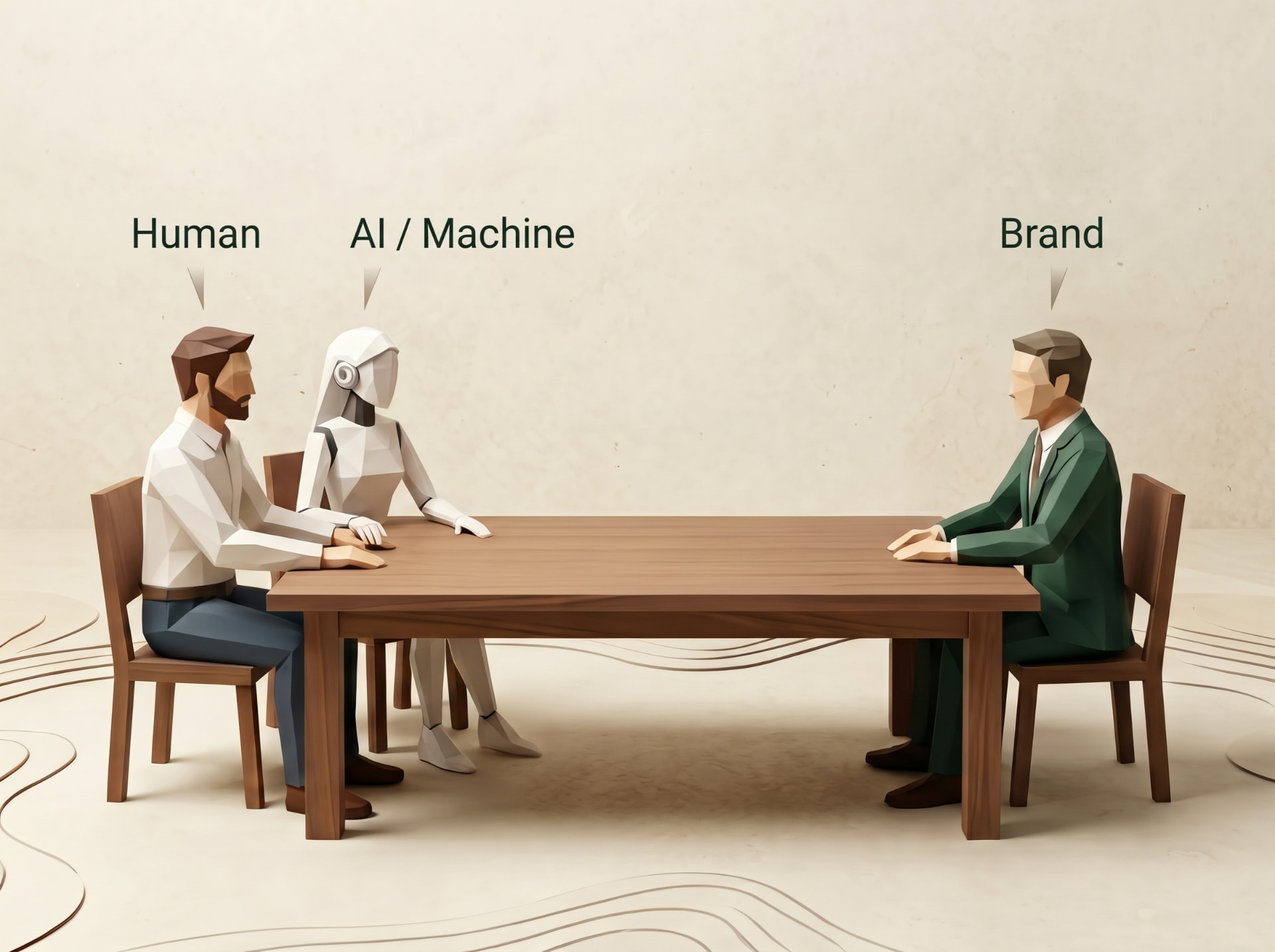
Gartner's explanation is elegant and slightly brutal: individually relevant content reinforces confirmation bias. It tells each stakeholder that their existing view is the correct one. You end up with a CTO convinced this is a platform decision, a CFO convinced it is a cost decision, and a COO convinced it is a workflow decision — each one validated, in writing, by you. You did not build a case. You armed four separate arguments and handed them out.
IV. Five moves for CMOs
I would not cancel the personalization roadmap. I would change its unit of design — from the individual impression to the buying decision — and make these five moves.
Start with the buying job, not the data field. Map the decisions the group must make: frame the problem, establish urgency, define requirements, build the business case, validate risk, create consensus and defend the choice. Then build content and experiences that make each decision easier. "Viewed pricing twice" is a signal. "Needs to defend a three-year payback to finance" is context.
Personalize the committee, not only the contact. Create one shared account narrative, then equip each role with the proof it needs. Finance needs economic logic. Technology needs architecture, security and integration. Procurement needs comparability. Users need adoption confidence. The messages can differ, but the value story must converge. A click is not a buying committee.
Match depth to signal confidence. Use broad category stories for weak or out-of-market signals, role-aware guidance for credible in-market behaviour, and one-to-one co-creation only when the account value and context justify it. AI is excellent at assembling approved modules. It should not turn a probabilistic signal into false certainty just because the workflow can.
Ask more. Infer less. Use diagnostics, assessments, configurators, value calculators and guided conversations to let buyers declare goals, constraints and risk. This is not a longer form disguised as customer experience. It is a fair exchange: the buyer gives context and gets clarity. Make the experience useful even if the buyer never books a meeting.
Orchestrate one truth and measure movement. Create a governed source of claims, evidence, pricing logic and implementation answers that marketing, sales, product and AI agents all use. Then measure buying-group coverage, shortlist inclusion, decision confidence, stage velocity, win rate, deal value, adoption and retention. Opens and click-through rates can remain on the dashboard. They just should not be allowed to run the meeting.
V. Personalization should reduce the work of buying
The best B2B personalization is often less visible than the technology used to create it. It feels like a shorter route to the right answer: the relevant proof appears before it is requested, the website and the seller agree, the CFO and the technology lead can use the same business case, and the buyer can see what will happen after the contract is signed.
That is why I would replace the ambition to be "hyper-personalized" with a harder standard: be decision-relevant. Use AI to listen, assemble, test and learn. Use human judgement to decide what is useful, what is defensible, and when silence is more respectful than another automated touch.
The question is not, "How many versions can AI create?" It is, "Did we make this decision easier, safer and more defensible for the buying group?" If the answer is no, the first-name token can take the rest of the day off.
FAQs
Is hyper-personalization dead in B2B?
No. Personalization works when it is a system capability. What fails is personalising an individual impression while ignoring the buying group's decision, which research shows can actively reduce consensus.
Why does individual personalization hurt buying-group consensus?
Because it reinforces each stakeholder's existing view. Every member gets confirmation of their own frame, so the group arrives at the decision with four validated arguments instead of one shared case.
What should B2B marketers personalize instead?
The buying job. One shared account narrative, with role-specific proof underneath it, measured on shortlist inclusion, decision confidence and stage velocity rather than opens and clicks.
How does AI fit in?
AI is excellent at assembling approved modules, testing and learning. It should not convert a probabilistic signal into false certainty. Read more in AI will not fix your marketing.
Want more of this in your feed? Set CMO++ as a preferred source.