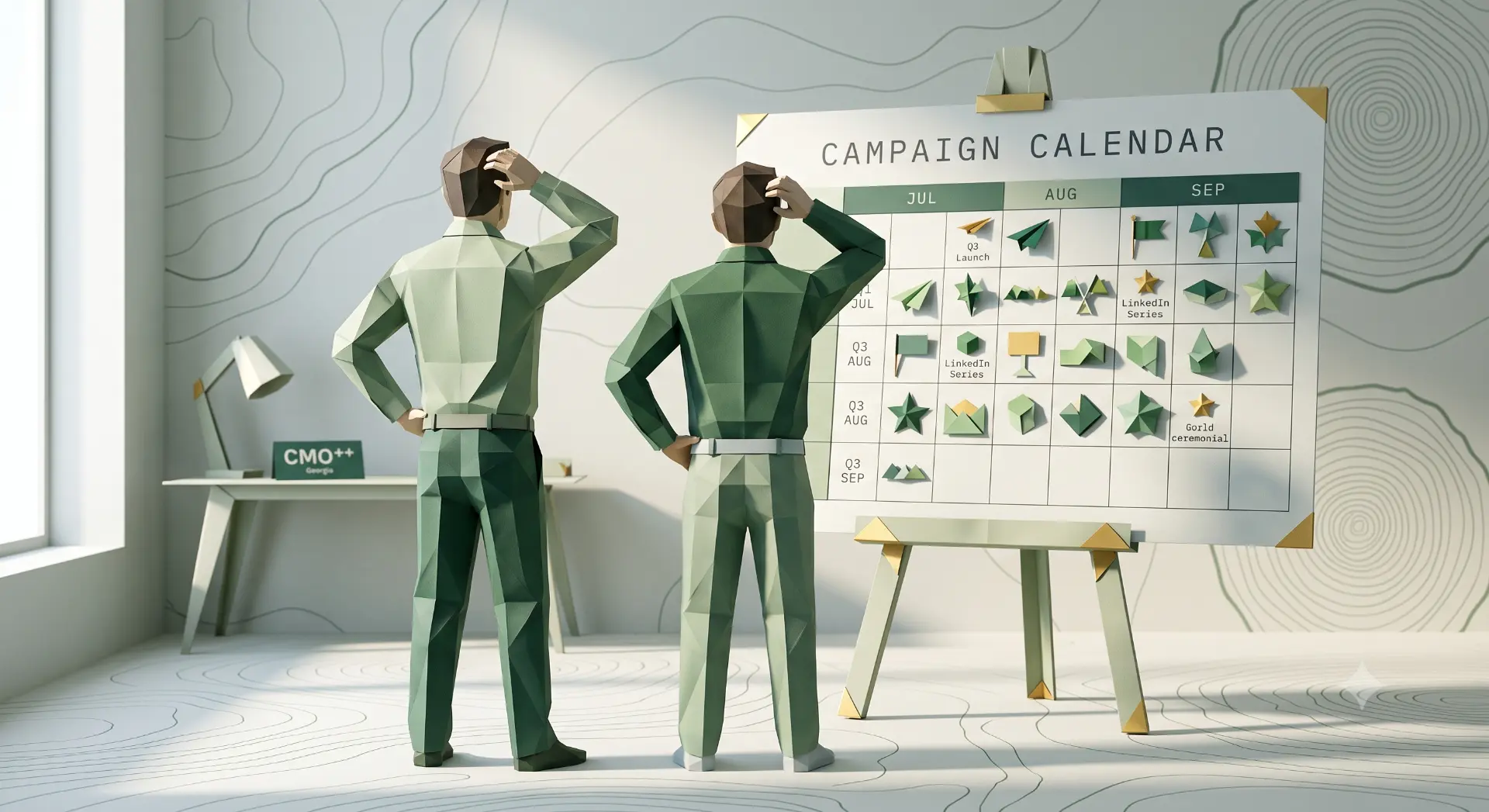
How I'd build a marketing org chart that's relevant today
Every box on your marketing org chart was once a rational answer to a real constraint. The constraints are gone. The boxes are not. Here is the work chart that replaces them.


Every layer in your marketing team exists because, at some point, a human being was the fastest way to move information from one place to another.
The brand manager existed because someone had to hold the line on consistency across regions. The campaign manager existed because six specialists needed a single throat to choke. The analytics lead existed because the data lived in four systems and someone had to make it agree with itself by Thursday.
Every box on that chart was, in its time, a rational answer to a real constraint. Today the constraints are gone. The boxes are not.
In a June 2026 research piece that should be mandatory reading for every CMO, Deloitte made a blunt argument: AI is not just accelerating tasks, it is vaporising the coordination and synthesis work that historically required layers of management. So instead of mapping people and reporting lines, we need to map tasks and processes. We need to draw how the work actually gets done.
That drawing is the work chart.
The collapse of the middle layer
We have been redrawing org charts for decades. Every new leader arrives, moves the boxes, renames "digital" to "growth", puts martech under operations, and calls it transformation. Almost none of it changes how long it takes to get a campaign live.
Deloitte identifies four reasons hierarchies form in the first place, and it maps onto marketing so precisely it is almost rude:
- Information latency. Data arrives late and in fragments, so people escalate to get clarity. That is your Monday performance meeting.
- Dependency load. Work depends on other teams, systems and approvals, creating queues. That is your creative brief sitting in legal review.
- Quality uncertainty. Without standardisation, humans check, double-check and validate. That is four rounds of amends on a landing page.
- Monitoring overhead. Status reporting eats the time that could be spent doing the work. That is the deck about the campaign taking longer than the campaign.
AI is exceptionally good at crushing these exact four bottlenecks: surfacing information continuously, reducing hand-offs, applying consistent checks, and reporting on itself. The meeting that justified the management layer just stopped justifying the layer.
The numbers back this up. Gartner predicts that through 2026, one in five organisations will use AI to flatten their structure. Meanwhile BCG found that in most large enterprises, the legacy marketing build process takes 60 to 90 days, involves 20 or more people, and produces a single campaign.
60 to 90 days. 20 people. One campaign. That is not 60 days of effort. That is 60 days of queue — the same tax I wrote about in the most expensive line item in marketing.
The thought experiment: rebuilding from zero
Close your current org chart. Open a blank page.
You are building a marketing function from zero today. You have AI agents, a unified data layer, and a small group of very good humans. Do you create a brand team, a digital team, a content team and a martech team?
Of course not. You would never invent separate functions whose primary shared activity is scheduling meetings with each other. We built a linear production line to serve a non-linear buyer, and then wondered why attribution felt like astrology.
If you organise around the customer journey — Discover, Decide, Buy, Adopt, Grow — you get five outcomes instead of six siloed functions. Each stage has a named human owner, a defined set of AI agents doing the coordination work, an explicit quality standard, and a number they are accountable for.
Meet the new humans
This is where the fear lives, so let us be specific. As McKinsey points out, the future belongs to hybrid human-agent teams. The humans move above the loop, not inside it.
Translate that into four jobs that actually exist in a marketing work chart:
- Orchestrators. They own a journey stage end to end and direct a mixed team of people and agents. Their skill is sequencing, not doing.
- Integrators. They make the seams disappear — between stages, between marketing and sales, between the data layer and the decision.
- Builders. They construct the systems: the agent workflows, the prompt libraries, the brand intelligence layer. In an agent-native model this is a marketing job, not an IT one.
- Standard-bearers. They hold taste, brand truth and factual accuracy. When output volume rises by an order of magnitude, human judgement becomes the scarce, highly valued input.
None of these is "the social media person". And all four require more seniority, not less.
Two red flags before you flatten
I would rather be useful than blindly exciting. Before you fire your org chart, heed two warnings.
1. Do not delayer a broken process. If you automate a broken process, you scale the breakdown. The coordination work returns informally through shadow approvals and undocumented escalations. You will have removed the layer but kept the delay. Map the work first, add guardrails, then fuse the roles. This is the same trap behind AI will not fix your marketing.
2. You are about to break the apprenticeship. AI is superb at the exact starter tasks that used to train junior marketers: first drafts, initial analysis. If you remove those tasks, how do juniors learn? Deloitte suggests "verification residencies", where associates audit AI-drafted assets against brand guidelines and factual accuracy, scoring each piece and arguing for the better version. Flatten without rebuilding this training ground and you get a very efficient marketing function in 2027 and zero marketing leaders in 2032.
Draw your work chart on Monday
You do not need a massive consulting engagement to start. You need a whiteboard and an honest afternoon.
- Pick one journey stage. Just one. I recommend Decide, where hand-offs are usually the most expensive — and where the hidden buyer does the most damage.
- Map the actual work loop. Every step from intake to live. Hand-offs are your unit of measurement, not headcount.
- Count the wait time. Measure the queue, not just the active work.
- Identify the pure information hand-offs. Those are the ones AI agents absorb. The ones that exist to apply human judgement stay.
- Write down the guardrails. What must carry a human signature — claims substantiation, brand standards? Let AI accelerate the making; keep the approving explicit and auditable.
- Name one accountable outcome owner. If two people own it, nobody owns it.
The org chart answers who reports to whom. In 2026 that is close to the least interesting question you can ask about a marketing team.
The work chart answers how a decision travels, where it waits, and who is accountable when it lands. Same people. Same budget. Radically different results.
So, a real, non-rhetorical question to leave you with: if you rebuilt your marketing function from zero next Monday, what is the first box on your current org chart you would refuse to draw again?
Frequently asked questions
What is a work chart? A work chart maps how work actually flows — the steps, hand-offs, wait times and decision points from intake to live — instead of who reports to whom. It is the operating view of a marketing function rather than the reporting view.
Does AI mean fewer marketing managers? It means fewer roles whose value is coordination and status reporting. Roles that hold judgement, taste, systems design and accountability for outcomes become more valuable, and more senior.
How does CMO++ help redesign a marketing org? CMO++ works inside your team to map the work loop, identify which hand-offs AI can absorb, set the guardrails that stay human, and name a single accountable owner per journey stage — then runs the operating rhythm until it holds.
Want more of this in your feed? Set CMO++ as a preferred source.