It’s About Time You Retire Your Campaign Calendar
The campaign calendar was a brilliant solution to a problem we no longer have — human throughput. Here is why the campaign is being demoted from the operating system of marketing to an application that runs on it.

It’s About Time You Retire Your Campaign Calendar!
Think about why campaigns exist in the shape they do. Research. Brief. Create. Approve. Launch. Analyse. Repeat. Every one of those steps had a human queue in front of it. Insights took 6 weeks because a team had to run the study. Creative took 8 because someone had to write, shoot, edit and route it for approval. Legal took 2 because legal always takes 2 😊
The calendar was simply that queue, made visible and given a name.
I have spent 25 years inside that system — in telecom, in enterprise technology, and latterly building an AI marketing practice. It works. It has produced most of the best work our industry has ever made. That is exactly why nobody stops to ask whether the thing it was designed to solve for… still exists.
What McKinsey is actually saying
In April 2026, McKinsey published a piece on reinventing marketing workflows with agentic AI. Most of the coverage seized on the big numbers — and they are big.
Agentic AI could come to power as much as two-thirds of current marketing activities. Organisations implementing agentic workflows can expect 10%- 30% revenue growth from hyper-personalised marketing. Agentic systems could accelerate the creation and execution of campaigns by ten to fifteen times. (McKinsey, April 2026)
But the sentence that matters is not a number. It is this one- "Marketing is no longer confined to campaigns and channels- it is becoming a real-time growth engine that integrates insights, content, commerce, and performance in a continuous loop."
Read that carefully. That is not a claim about speed. It is a claim about structure.
To be clear- campaigns are not dead
Launches are real. Events are real. Seasonal peaks, category-creating bets, the big brand statement that needs to land in one moment with full force- all real, all still requiring the concentrated, deliberate, expensive thing we call a campaign.
What is becoming obsolete is the campaign as the primary organising unit of marketing. As the default container into which all activity is poured. As the unit by which budget is allocated, teams are structured, agencies are retained, performance is reviewed and careers are measured.
That is a different claim, and a much harder one to act on- because the organising unit is invisible. It is not a line item you can cut. It is the shape of the whole thing.
The hidden cost of batch processing
Here is the mechanism, and it has nothing to do with technology.
When the campaign is your organising unit, marketing runs in batches. And batch processing has a specific, expensive failure mode- learning gets trapped inside the batch.
You launch. 6 weeks in, a signal appears, a segment responding differently, a message landing harder than expected, a channel underperforming. What happens to that signal?
Usually, it waits. It goes into the wash-up deck. The wash-up happens 3 weeks after the campaign ends. By then the team has rotated onto the next thing, the budget is committed, and the insight becomes a bullet point in a deck nobody reopens. The next campaign starts from roughly the same place the last one did.
This is why so much marketing feels like it is running hard without compounding. Not because the work is poor. Because the architecture discards learning at the end of every cycle by design.
Continuous systems do not have this problem. That is the entire point of a loop.
Why this is the same story as the AI RoI problem
McKinsey has a name for the mess most marketing teams are currently in- the GenAI paradox - the technology can be found everywhere, except on the bottom line.
The evidence is stark. Nearly 90% of CMOs are experimenting with AI use cases. Fewer than 10% have captured value across end-to-end workflows.
That gap is not a technology gap. It is a structural one. We took a continuous, learning technology and inserted it into a batch-processing organisation. So it made each batch faster. The brief gets written in an hour instead of a week. Forty creative variants instead of four. Reporting automated.
And then all of it still waits for the next campaign cycle, because the cycle is the thing we never questioned.
You cannot get a continuous return out of an episodic operating model.
What the new shape looks like
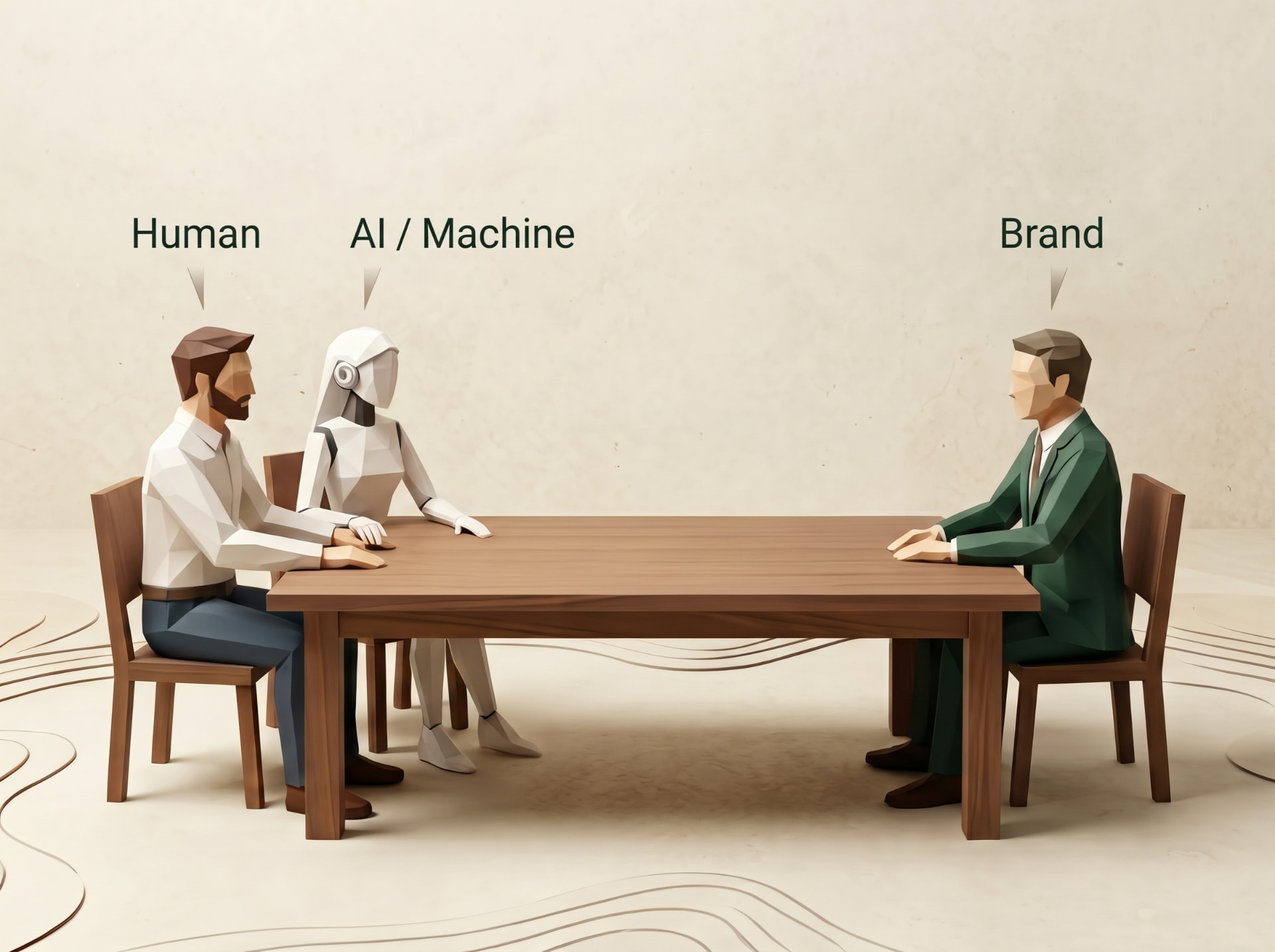
Humans own four things. Direction- what we are trying to move, and why. Judgment- taste, cultural read, the call that cannot be derived from data. Boundaries- what the brand will and will not say, the legal and reputational perimeter. And intervention- knowing when to stop the system, override it, or change its objective.
Agents own the rest. Sensing signals, adapting, generating, testing, executing, and doing it continuously rather than in cycles.
McKinsey's framing is that one marketing professional supervises a team of agents. Note what that does to the job. The person who used to own the calendar now owns the system.
That is not a promotion or a demotion- it is a genuinely different profession, and most of our teams have not been trained for it.
McKinsey also flags something that gets lost in the excitement- interoperability, not model design, is usually the limiting factor. Not which model you chose. Whether your CRM platform, content systems, asset library and analytics can actually talk to each other in real time. Most cannot.
5 things I would change before I changed the technology
1. Fund the engine, not the burst. As long as budget is allocated campaign by campaign, the calendar survives no matter what tools you buy. Money shapes structure more reliably than strategy does.
2. Brief boundaries, not deliverables. The creative brief was built to commission a finite thing. What a continuous system needs is a standing definition of the perimeter- what we are optimising, what we will never say, where the brand line sits. Fewer briefs, better-written, longer-lived.
3. Replace the wash-up with telemetry. If learning is only extracted at the end, you have not built a loop- you have built a shorter batch. Ask where a signal spotted on a Tuesday goes.
4. Decide the unit of optimisation, explicitly and in writing. Individual, buying group, or account. Get it wrong and you will scale the error faster than you have ever scaled anything.
5. Name the system owner. Someone senior whose job is the engine, not the next launch. If nobody owns it, the calendar quietly reasserts itself within two quarters. It always does.
The reframe
The campaign calendar was a brilliant solution to a problem we no longer have- the problem of human throughput. It made a slow, fragmented, approval-heavy process legible and manageable. It deserves respect.
But it was always scaffolding, and the building has changed.
The campaign is not dying. It is being demoted- from the operating system of marketing to an application that runs on it.
The calendar told us when to speak. It was never able to tell us when to listen.
So, a question I would genuinely like other marketing leaders to answer- if you removed the campaign calendar from your organisation tomorrow, what would actually hold the work together?
If the honest answer is "nothing", that is not a reason to keep it. That is the finding. 😊
FAQ
Are marketing campaigns dead? No. Launches, events and seasonal peaks still need concentrated, deliberate effort. What is changing is the campaign's role as the primary organising unit of all marketing activity.
What is replacing the campaign calendar? A continuous growth engine — a loop where insights, content, commerce and performance feed each other in real time, supported by agentic AI and clear human ownership of direction, judgment, boundaries and intervention.
Why does AI not show up on the bottom line yet? Because most teams inserted a continuous technology into an episodic operating model. AI made each batch faster, but the batch structure still discards learning at the end of every cycle.
What should a marketing leader do first? Restructure budget, briefs and ownership before buying more tools. Fund the engine, not the burst. Brief boundaries, not deliverables. Name a system owner.
How does CMO++ help with this transition? CMO++ acts as an embedded marketing leadership and execution partner. We help leadership teams redesign the operating model, build agentic workflows and keep the human judgment layer intact while scaling output.
Want more of this in your feed? Set CMO++ as a preferred source.