Your Brand Now Has Two Audiences: Humans and Machines
Why the next era of brand building will require marketers to be emotionally compelling to people, and evidentially legible to AI.

Numbers worth knowing
of consumers were already using AI-powered search in late 2025.
Source: McKinsey & Companyof AI citations were "ghost citations": the source was used, but the brand was not mentioned.
Source: Semrush, 2026of consumers trusted human reviews, versus a smaller proportion trusting AI recommendations alone.
Source: AdobeIntroduction
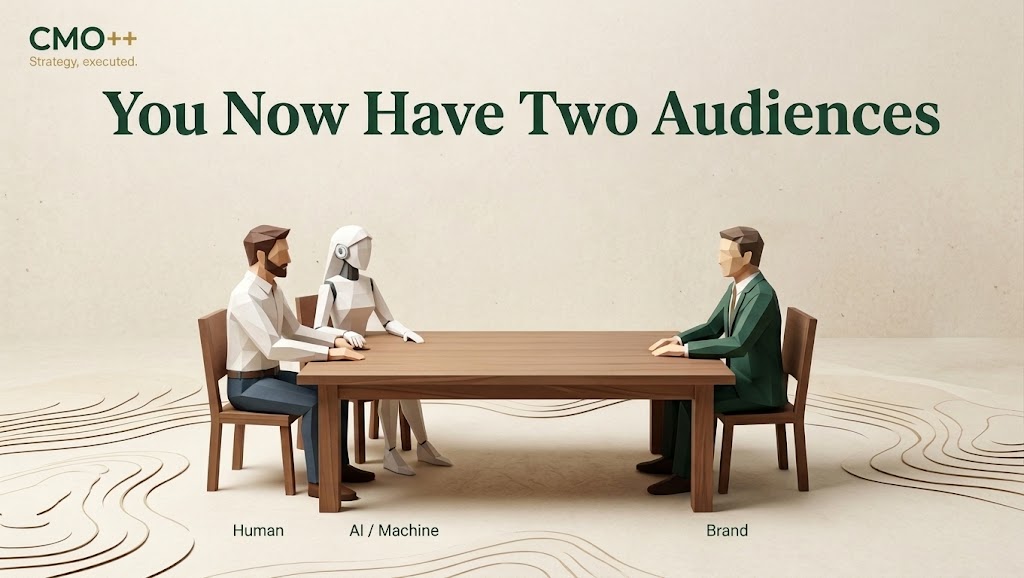
Your brand now has two audiences
For most of my career, the job of brand building was fairly clear.
Make people notice you. Make them remember you. Give them a reason to believe you. And, eventually, a reason to choose you. We obsessed over the things humans respond to: stories, emotion, distinctive assets, tone of voice, cultural relevance, experience.
That job hasn't disappeared.
But somewhere between ChatGPT becoming a shopping assistant, Google putting AI answers above traditional results, and consumers asking machines questions such as "Which enterprise platform is best for a mid-sized bank migrating to the cloud?", something fairly fundamental changed.
Your customer may no longer encounter your brand first. Their AI might.
And that creates an unusual new marketing challenge.
Your brand now has two audiences.
One has emotions. The other has retrieval systems.
And increasingly, the second one influences what the first one sees.
The shift
We spent decades designing brands for human memory. Now we also need to design them for machine retrieval.
Think about the traditional customer journey.
A buyer had a need. They searched Google. They visited websites. They read analyst reports. They asked colleagues. They compared alternatives. Marketing's job was to appear somewhere along that journey and persuade them.
Now imagine the same buyer opening an AI assistant and asking:
"I'm looking for a customer data platform suitable for a regulated financial-services company operating across India and the Middle East. Which three should I consider, and what are their strengths and weaknesses?"
The buyer may never see ten blue links. The machine researches, compares, compresses and presents an answer. Google itself describes AI Mode as particularly useful for complex comparisons and says it can use "query fan-out", conducting multiple searches across subtopics and data sources before constructing a response. Google for Developers
ChatGPT is moving in a similar direction in commerce. OpenAI says people are increasingly beginning shopping journeys in ChatGPT to explore, compare and decide what to buy, with product discovery drawing on merchant data, public product information and other retail sources. OpenAI
McKinsey describes AI search as a new "front door to the internet" and reported in late 2025 that about half of consumers were already using AI-powered search. McKinsey & Company
This isn't simply SEO with a shiny new acronym. It changes who or what interprets your brand before your customer does.
Exhibit 1
The new brand journey
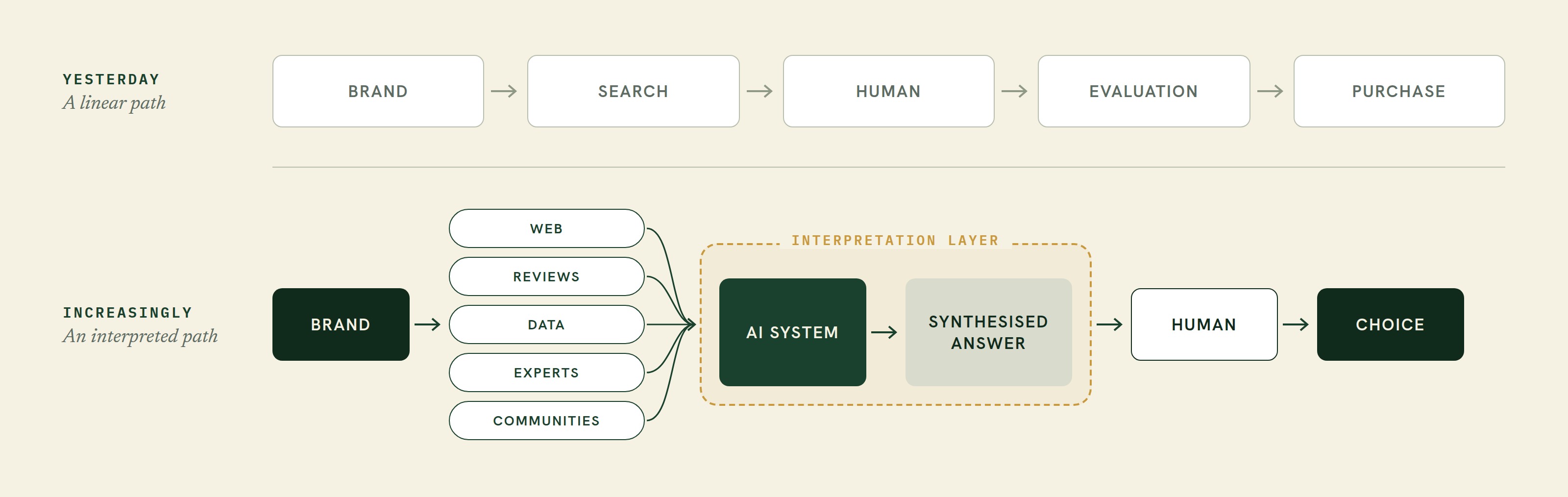
There is now an interpretation layer sitting between the brand and the buyer.
And marketers don't entirely control it.
The two audiences
Here's the interesting bit. Humans and machines don't necessarily evaluate brands in the same way.
A human encounters Patagonia and may think purpose. Apple may evoke design. Volvo may trigger safety. These associations have been built through decades of storytelling, product experience, advertising, culture and repetition.
But ask an AI system to recommend something and it needs evidence from which to construct its answer. It may encounter product descriptions, comparison pages, customer reviews, articles, expert commentary, structured product information, community discussions, FAQs, and your own website.
In commerce, for example, ChatGPT says its product experience can incorporate product details, ratings, reviews and merchant/product metadata; merchant ranking can consider factors including availability, price, quality and whether the seller is the maker or primary seller. OpenAI Help Centre
So we are moving from one brand equation to two.
Exhibit 2
The dual-audience brand
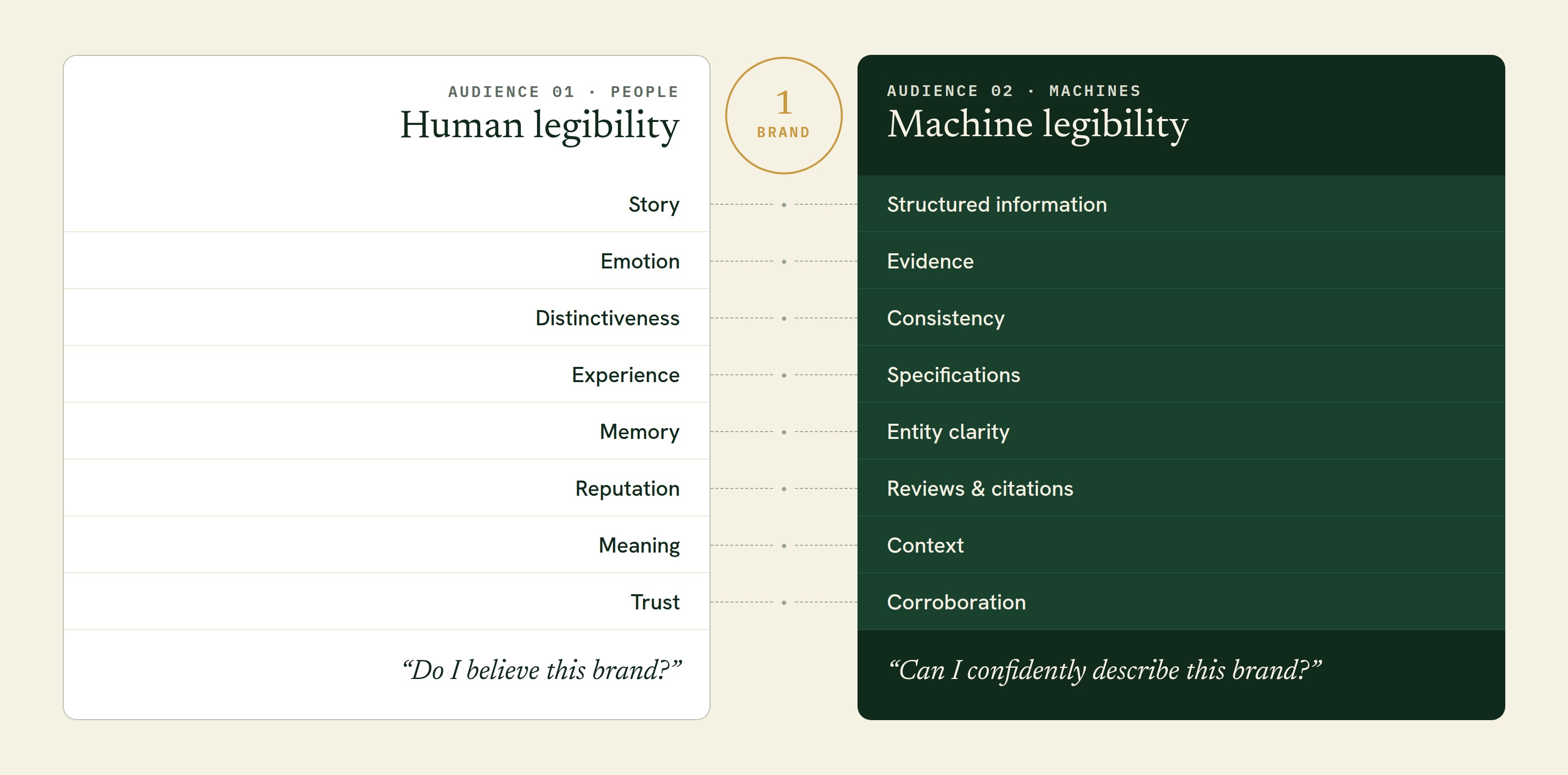
And the brand of the future needs both.
Emotion without evidence may become invisible. Evidence without emotion becomes interchangeable. That is the new brand problem.
The machine doesn't just read your website
This is where I think many marketers will get caught.
We will treat Generative Engine Optimisation (GEO), Answer Engine Optimisation (AEO) or whatever acronym survives the next twelve months as another job for the SEO team.
Add some schema. Rewrite some FAQs. Job done.
Except it isn't.
Google explicitly says there is no special AI schema or machine-readable file required to appear in AI Overviews or AI Mode. Its advice remains remarkably unglamorous: create useful, reliable content; ensure important information exists as text; keep structured data consistent with visible content; maintain accurate merchant/ business information; and follow sound technical SEO. Google for Developers
The bigger issue is what the wider internet knows about you. Because machines don't necessarily take the beautifully crafted sentence on your homepage at face value.
Imagine your website says:
"The most trusted enterprise AI platform."
Lovely.
Now imagine the rest of the internet says almost nothing about you.
Few independent reviews. No authoritative commentary. Inconsistent product descriptions. Old documentation. Different descriptions on LinkedIn and partner sites. No useful comparison pages. Very little expert content.
To a human, the claim may sound confident.
To a machine, it is a claim looking for witnesses.
That distinction matters because AI visibility is not synonymous with website visibility.
A 2026 Semrush study across 3,981 domain appearances found that 61.7% of AI citations were "ghost citations": the source was used, but the brand itself wasn't mentioned in the generated answer. It also found comparative content generated substantially more brand mentions than purely informational content. Semrush
That's a fascinating new marketing problem.
Your content can be useful enough for the machine to learn from while your brand remains invisible.
From share of search to share of answer
For years marketers tracked search rankings. Position 1. Position 3. Page 1.
AI interfaces break that mental model. There may be no neat list of ten competitors anymore.
There may simply be:
"Here are the three options I'd consider."
Which means marketers will increasingly need another metric
Share of Answer
Not merely
"Where do we rank?"
But
"When our category is discussed by AI systems, are we part of the answer, and how are we described?"
That second part is important.
Because being mentioned isn't enough.
You might want your company associated with enterprise-grade cybersecurity while machines repeatedly describe it as a low-cost cybersecurity tool for small businesses.
Congratulations. You have AI visibility. Unfortunately, it's for the wrong brand.
So I would measure four things:
| MEASURE | QUESTION |
|---|---|
| Presence | Does the brand appear? |
| Positioning | What is it associated with? |
| Proof | What evidence supports that description? |
| Preference | In what contexts does it enter the consideration set? |
This starts turning "AI visibility" from an SEO metric into a brand-management discipline.
The review you ignored may now be part of your brand
There is another implication that marketers shouldn't underestimate.
For years, many companies treated reviews, Reddit threads, analyst commentary, partner pages and customer conversations as peripheral reputation channels.
AI makes them potential inputs into discovery.
Research into AI-search behaviour is still evolving and platform-specific, so marketers should be wary of universal recipes. But studies are already showing that third-party and community sources can play an outsized role in AI citations and brand descriptions. Semrush
Meanwhile, consumers haven't suddenly outsourced trust entirely to machines. One Adobe survey found 63% of consumers trusted human reviews, versus a smaller proportion trusting AI recommendations alone. Adobe
Which creates a lovely irony.
Machines may become more influential precisely because they can synthesise what humans have said.
Reviews aren't just reputation management anymore.
Customer stories aren't just sales collateral.
PR isn't just awareness.
Expert commentary isn't just thought leadership.
Community conversations aren't just social listening.
They are increasingly part of the evidence layer of the brand.
Exhibit 3
The brand evidence graph
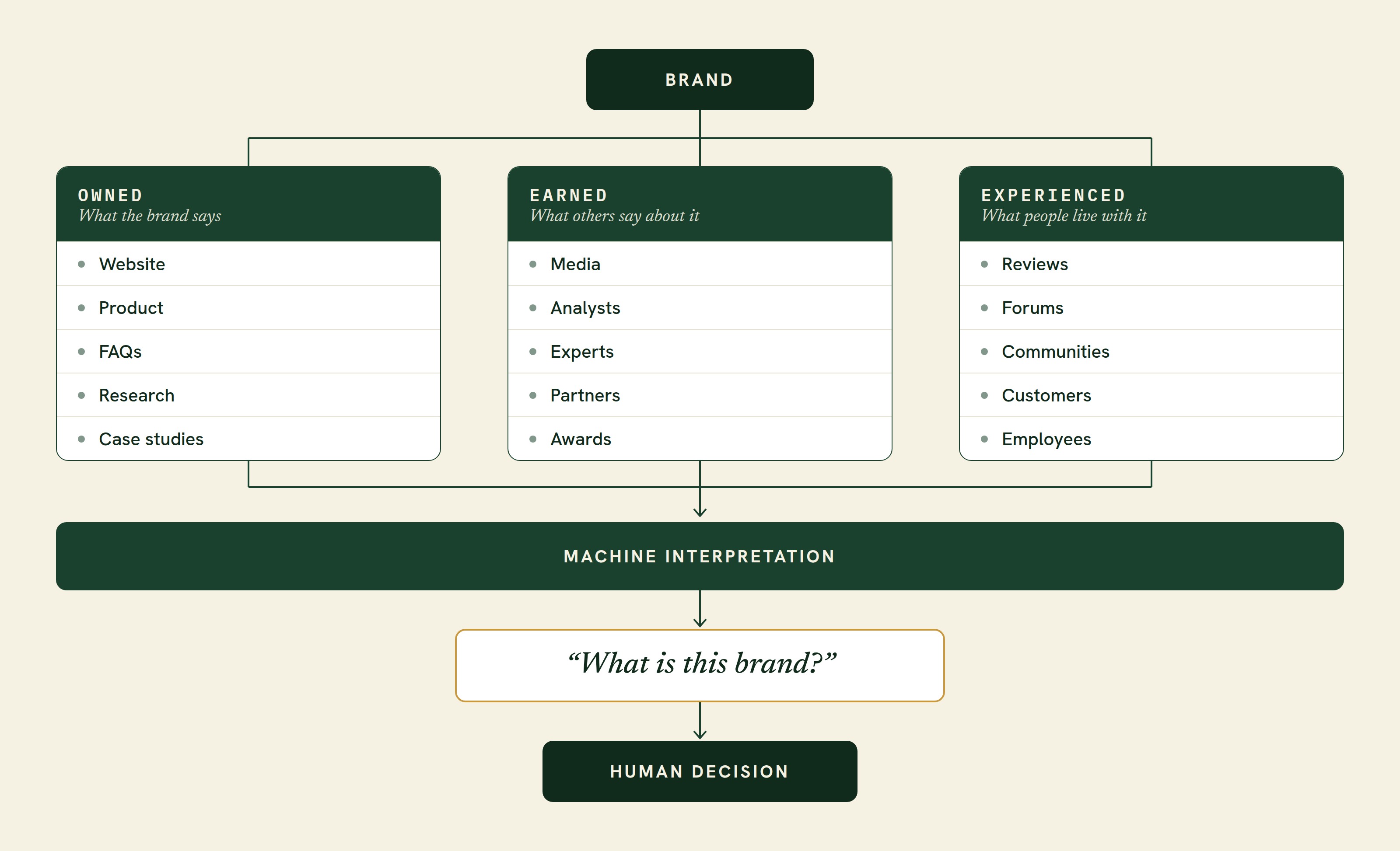
The implication is quite profound.
Brand consistency can no longer mean only visual consistency. It must also mean evidential consistency.
This doesn't mean we should start writing for robots
This is the bit I'd worry about most.
Marketers have a remarkable ability to destroy a useful idea by optimising it.
We did it with SEO.
Perfectly intelligent writers suddenly began producing sentences like:
"If you're looking for the best enterprise cloud platform enterprise cloud solution for your enterprise cloud needs..."
Please don't let GEO do the same thing. Because the evidence so far points in a more sensible direction.
Google continues to emphasise helpful, reliable, people-first content, not pages manufactured specifically for AI systems. Google for Developers
And consumer behaviour suggests that AI-driven discovery can send unusually intentional visitors onward. Adobe reported that US retail traffic originating from generative AI sources rose sharply during 2025; those visitors also showed longer visits and higher engagement than traffic from non-AI sources in Adobe's dataset. Adobe for Business
So the objective isn't
write for machines instead of humans.
It is***
make excellent human content easier for machines to understand, verify and retrieve.
That's very different.
The framework: Story + Signal + Structure + Substantiation
If I were building a brand today, I'd add four layers to the traditional brand system.
1. STORY Give humans something to care about.
This is classic brand building.
Purpose. Point of view. Personality. Distinctiveness. Memory structures. Experiences.
Don't abandon any of it. In fact, as AI makes functional content cheaper and more abundant, genuine brand character probably becomes more valuable, not less.
2. SIGNAL Be unmistakably clear about what you are.
A surprising number of brands are poetic precisely where they need to be precise.
Your homepage should allow a person and a machine to answer
Who are you? What category are you in? Who are you for? What problem do you solve? Where do you operate? Why are you different?
That doesn't require dull writing. It requires clarity.
At CMO++, for example, we deliberately describe ourselves as a senior extended marketing team for B2B technology companies, rather than relying solely on an abstract proposition.
The story can then do its job. But the entity is clear.
3. STRUCTURE Make your knowledge retrievable.
Product pages should contain actual product information.
Case studies should contain actual outcomes.
Expert articles should answer identifiable questions.
Pricing, where appropriate, should be comprehensible.
FAQs should answer questions rather than contain sales copy disguised as answers.
Important information shouldn't exist only inside a beautiful image or video.
Structured data should correspond to what users can actually see, something Google explicitly recommends. Google for Developers
4. SUBSTANTIATION Give the internet reasons to believe you.
This may become the most important layer.
Reviews.
Customer evidence.
Case studies.
Independent mentions.
Original research.
Expert commentary.
Partner ecosystems.
Author credentials.
Consistent facts across channels.
Machines need corroboration.
Humans do too.
Exhibit 4
The Brand² model
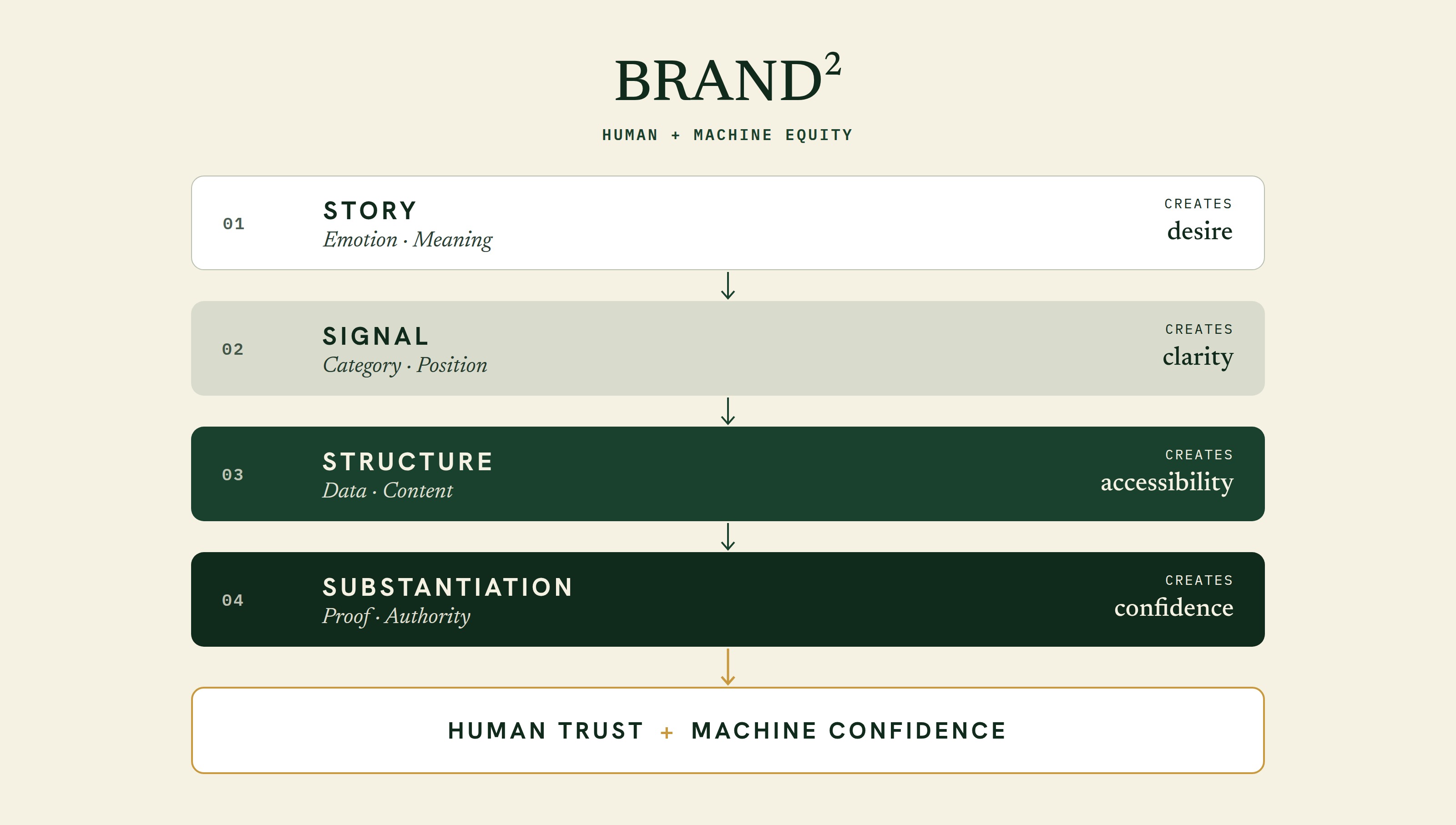
The order matters.
Story creates desire.
Signal creates clarity.
Structure creates accessibility.
Substantiation creates confidence.
What I would ask my marketing team tomorrow
Not "What's our GEO strategy?"
I'd start somewhere more uncomfortable.
Open ChatGPT, Gemini, Perplexity and Google AI Mode and ask the kinds of questions your customers genuinely ask.
Not your brand name.
Your category questions.
"What's the best...?"
"What should a company like mine consider when...?"
"Compare..."
"Which providers specialise in...?"
"What are the risks of...?"
"Who should I shortlist if...?"
Then document what happens.
Do you appear?
Who appears instead?
What attributes are associated with them?
What sources are being referenced?
How accurately are you described?
Where did the machine get that description?
Do your website, LinkedIn presence, reviews, media coverage and partner ecosystem tell roughly the same story?
Now you have the beginnings of an AI Brand Audit.
I'd run that audit across five layers: Discovery → Description → Evidence → Consistency → Conversion.
And I'd repeat it, because AI answers are probabilistic and change over time. A single prompt on a single platform is not research.
The bigger ramification: marketing's job is expanding again
For years we've talked about managing the customer journey.
Perhaps the next marketing operating model has to manage something larger
the customer journey + the machine interpretation journey.
That affects far more than SEO.
Brand teams will need stronger connections with product data.
Content teams with knowledge architecture.
PR with AI visibility.
Customer experience with review ecosystems.
Commerce teams with product feeds.
Analytics teams with AI referral and brand-mention monitoring.
And marketing leaders will need to understand how all of those signals combine.
This is exactly why I think AI is exposing some old organisational weaknesses rather than merely introducing new technology.
The machine doesn't care which department owns the information. It simply encounters the organisation we have put onto the internet.
Messy company in.
Messy brand out.
Don't optimise your brand for AI. Make your brand easier to know.
There is a temptation with every new technology cycle to invent an entirely new marketing discipline.
Perhaps some of that will happen here.
But I suspect the lasting lesson will be much simpler.
The best brands for the AI era won't be those that learn how to manipulate machines.
They'll be the ones that become extraordinarily clear about who they are, what they do and why they deserve to be believed, and leave enough consistent evidence across the digital world for both humans and machines to reach that conclusion.
For humans, build meaning.
For machines, build evidence.
For both, build trust.
Because the next time someone asks,
"Which brand should I consider?"
your first audience may not be the person asking the question.
It may be the machine answering it.
And that machine has never seen your beautiful brand film.
It has seen your evidence.
Related reading: The Kitchen Gadget CMO, AI will not fix your marketing, and Meet the Hidden Buyer.
Want more of this in your feed? Set CMO++ as a preferred source.